When Your East Texas Yard Needs a French Drain (And When It Doesn't)
Half the yards I get called out to for a French drain don't need one. The water problem is real, but the fix is usually cheaper, simpler, and above ground. Here's how to tell the difference before you pay to bury a pipe.
Nobody calls me about drainage in a dry spell. They call the Monday after three inches of rain, when the back corner is still a pond, the dog is tracking mud inside, and the St. Augustine has gone slick and yellow in a low spot that never dries out.
And almost every one has already decided they need a French drain. It's the term everybody knows. But a French drain is one specific tool for one specific problem, and installing one where it doesn't belong is an expensive way to not fix your yard. So before we dig, I walk the property and ask one question.
First, figure out where the water is actually coming from.
Standing water is a symptom, not a diagnosis. Out here it comes from three different places, and each one has a different fix.
The first is water landing on your yard from above: rain sheeting off the roof, off a neighbor's lot that sits higher, off a driveway that slopes back toward the house. This is surface water, and it's the most common by a mile.
The second is water that has nowhere to go once it lands, because the ground is dead flat or tips the wrong way. A lot of Gregg County lots were graded to drain when the house was built and have settled since.
The third, and rarest, is water coming up from below or moving sideways through the soil: a spring, a seep at the base of a slope, or a spot where our heavy red clay traps water underground for days. That's the only one of the three a French drain is genuinely built for.
Here's the East Texas catch: our soil. A lot of this area sits on tight clay, and clay barely drains. Water doesn't soak in like it would in sand. It sits on top, or it perches in a shallow layer. That's why a French drain in clay has to be built right to do anything, and why so many yards can be fixed on the surface instead.
A lot of "drainage problems" are really downspout problems.
The cheapest fix I install isn't a drain at all. It's fixing where your roof water goes.
A typical roof dumps a stunning amount of water at the foundation, and if your downspouts end in a splash block two feet from the wall, that water has to cross your yard to get anywhere. On flat clay, it just spreads out and sits. People look at that soggy strip and assume they need a subsurface drain, when they just need to send the roof water somewhere on purpose.
What to do instead: before you spend a dime on a French drain, extend the downspouts and, if the yard has any fall at all, tie them into a solid (not perforated) pipe that carries roof water out to daylight, a curb, or a lower part of the lot. Solid pipe, because the point is to move that water past the problem, not leak it back into the same clay. On a lot of yards this alone dries up the soggy spot, at a fraction of a drain's cost.
The negative-slope trap next to your foundation.
Walk the first ten feet of ground around your house. It should fall away from the foundation, dropping about six inches over those ten feet. On older Longview homes it often doesn't: the soil has settled, or a flower bed got built up over the years, and now the grade tips back toward the slab.
When that happens, every rain runs toward the house and pools against the foundation. That's not just a soggy-yard issue, that's the beginning of a foundation issue, and no buried pipe fixes a slope that runs the wrong way.
What to do instead: regrade it. We bring in soil, re-establish positive fall away from the house, and shape a shallow swale (a wide, gentle grassed channel) to carry water around the structure to a low point. Grading is boring compared to a French drain, but on a lot of properties it's the actual fix, and it protects the most expensive thing on the lot. Done right, grass grows over the swale and you never see it.
When you actually need a French drain.
So when is it the right call? A true French drain, a gravel-filled trench with perforated pipe wrapped in filter fabric, is for collecting water that's already in the ground and can't get out. That means:
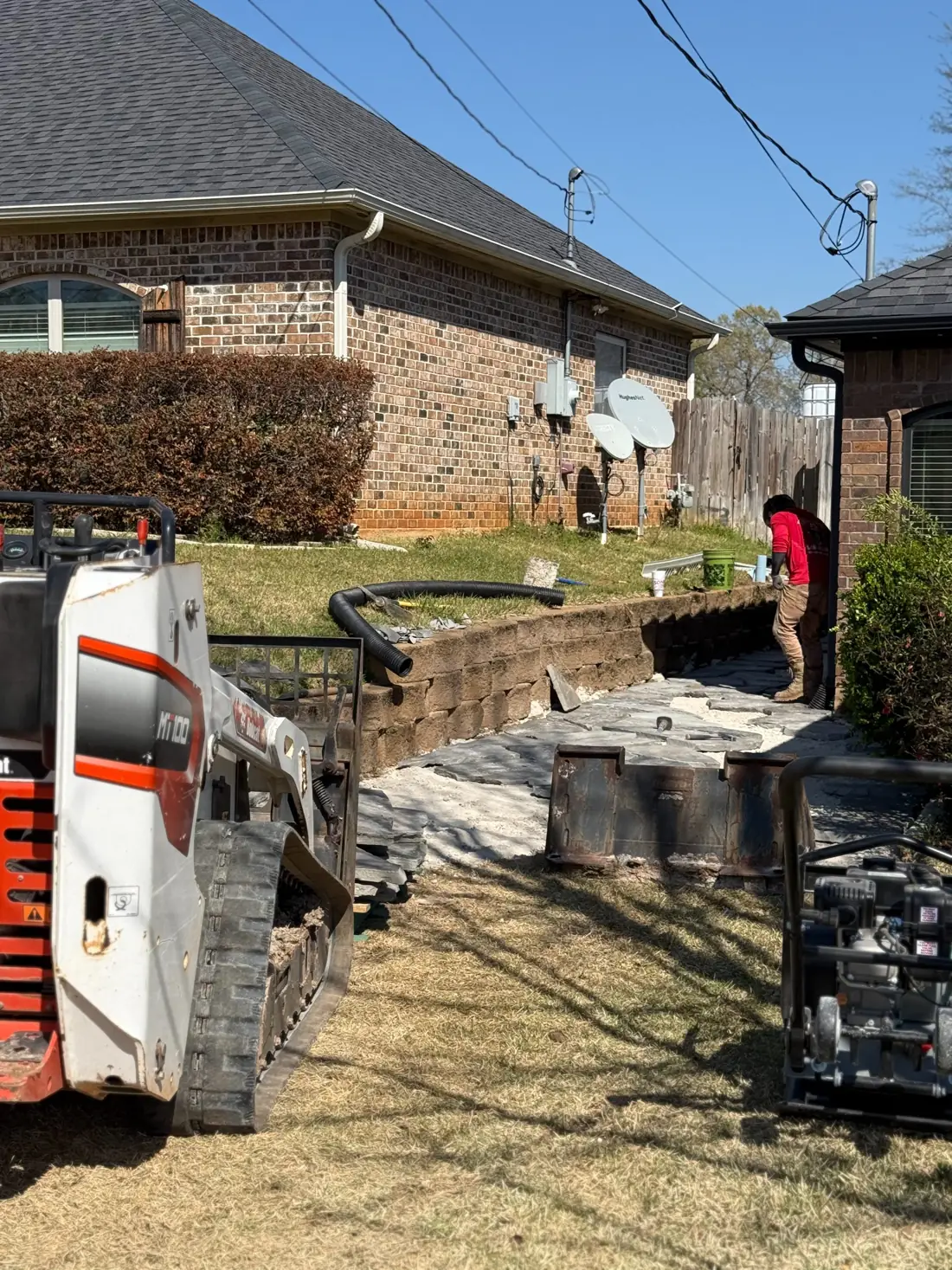
A chronically wet, spongy area that stays saturated for days after everyone else's yard has dried out. A low spot on a dead-flat lot where surface fixes have nowhere to send the water. A slope where water seeps out at the bottom and keeps the toe of the hill wet. Or a retaining wall, where drainage behind it isn't optional: it's the difference between a wall that lasts and one that bows out in a few years.
In those cases the French drain earns its keep: you're intercepting subsurface water and giving it a fast path out. But it only works if it's built for our clay: dug deep enough, sloped toward a real outlet, wrapped in fabric so clay fines don't clog the gravel, and daylighted somewhere the water can actually leave. A French drain that dead-ends into more clay is just a buried bathtub.
What a real French drain costs, and what a cheap one costs later.
I'll be straight about pricing, because people are always surprised. A properly built French drain in East Texas clay isn't a weekend project. You're paying for real excavation, washed gravel, quality perforated pipe, filter fabric, and a graded outlet, and most residential runs land in the range of a few thousand dollars, depending on length, depth, and where the water has to go.
That sounds like a lot next to a $200 roll of pipe from the box store. But the box-store version, laid shallow with no fabric and no real outlet, silts up with clay in a season or two and quits. Then you pay to dig it back up and do it again. The expensive part of drainage isn't the pipe, it's the digging, and doing that twice is how a cheap drain becomes the most expensive one.
What to do instead: get someone to diagnose the water before anyone quotes a drain. If the honest answer is downspouts and a regrade, that's what we'll tell you, and you'll spend less. If it really is a French drain, have it built once, built right, with a real outlet, so you never think about it again.
Figure out the source before you bury anything.
Standing water always has a source: roof water gets redirected, wrong-way slope gets regraded, and only trapped subsurface water really calls for a French drain. We diagnose and fix drainage on yards all over Longview, Hallsville, White Oak, Kilgore, and Gladewater, and we'll tell you honestly whether your soggy corner needs a bit of downspout work or a full drain. If your yard turns into a pond every time it rains, let's walk it and find where the water's really coming from.

Miller Maines owns Yard Dog Landscapes in Longview, TX. He has worked East Texas yards since 2017 and still walks every property himself.