
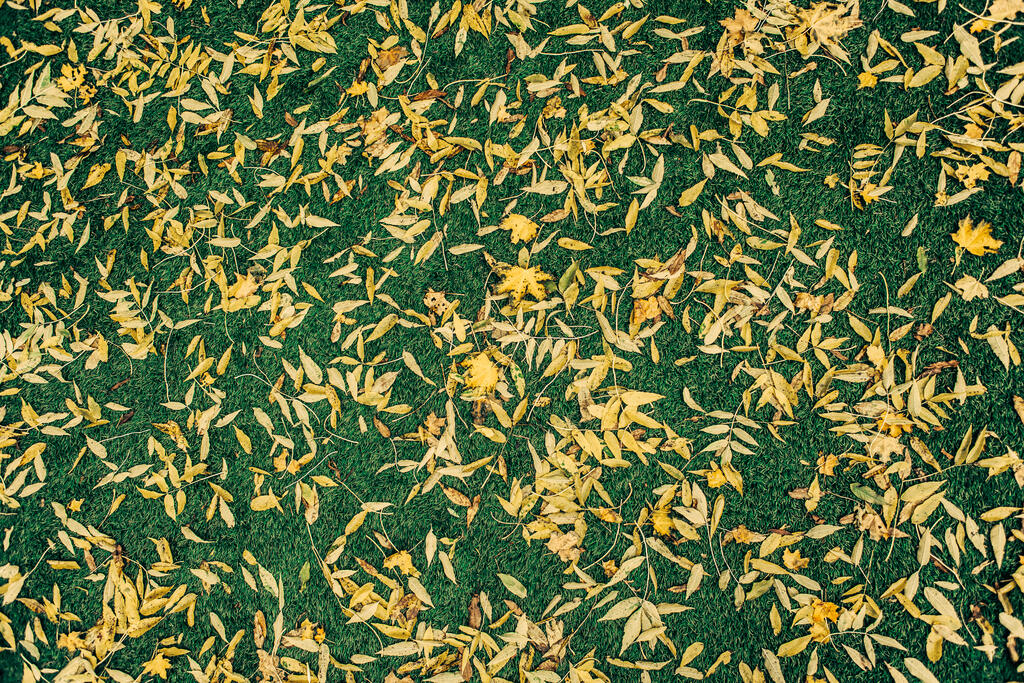
Somewhere in the first two weeks of October, usually right after the first cool front holds for a few days, yards around Longview pick up a light yellow scatter. Pecans go first out here. They drop early and they drop messy, and in a dry September they will dump half a canopy before anything else has thought about changing color.
That is the call I get every year. Somebody wants the leaves gone. For the first several weeks, my honest answer is that we should run the mower over them and leave them where they fell.
The first leaves of October belong in your lawn, not in a bag.
A leaf is mostly carbon, with a useful amount of potassium and a little nitrogen and phosphorus in it. Run it through a mower deck twice and it becomes confetti small enough to fall between the grass blades and land on the soil, where soil life takes over and finishes it in a few weeks.
What you get out of that is real, if unglamorous. Organic matter going back into the top inch of soil, which is exactly what our tight red clay is short on. A thin cover that holds moisture through the dry stretch we usually get in October. And a useful amount of potassium, which happens to be the nutrient warm-season grass wants going into winter. You also are not paying anybody to haul it off.
What to do instead: for the first light drop, mow like normal but raise the deck a half inch and make two passes at right angles. Do it when the leaves are dry. Damp leaves clump, clog the chute, and come out as wet wads that sit on top of the grass instead of falling through it. If your mower takes a mulching blade, put one on in early October.
The line is whether you can still see grass when you are done.
There is no magic leaf depth, and I do not trust the numbers quoted online, since they come from trials on cool-season lawns up north. My test is simpler: make the pass, stand back, and look. If the lawn reads green with shredded leaf bits worked down into it, you did the right thing. If it reads brown, you put a blanket on your grass.
Over that line, pick up the excess instead. You cannot mulch your way out of it, because two passes on too many leaves just makes a finer, denser mat, and a fine mat seals tighter than a coarse one.
Leaf type matters more than people expect. Pecan and southern red oak shred easily and disappear fast. Sweetgum is big, leathery, and slow, and the gumballs beat up a deck and bounce out at your ankles. Post oak is the stiffest and slowest thing in the yard to break down. Pine straw should not go through the deck at all: leave the needles for the beds, where they are genuinely good mulch.
St. Augustine is the grass that pays for the mistake.
Bermuda has a real advantage here. It goes dormant early and grows from underground rhizomes, so a bermuda lawn under leaves in December is mostly just ugly. Clear it before spring green-up and a few weeks of winter cover will not kill it.
St. Augustine is a different animal. It grows from stolons that run along the surface, so every growing point it owns sits right where the leaves land. And it stays partly green out here into November, sometimes December, because Gregg County often does not get a hard freeze until late in the month.
So you get a grass that is still alive and still needs light, buried under a wet leaf mat, at soil temperatures in the 60s and low 70s. That is the ideal setup for large patch, the fall and spring version of the fungus people call brown patch in summer. It wants exactly that window and exactly that moisture. Come March, the homeowner finds circles of St. Augustine that never came back and calls it winterkill. Often it was a leaf mat, not the cold.
What to do instead: if you have St. Augustine under pecans, sweetgums, or post oaks, treat November leaf cover as urgent rather than cosmetic. On a heavy-canopy lot that means clearing weekly for three or four weeks, more often than most people plan for. Under bermuda in full sun you have more slack.
Leaf litter in beds does less than the internet promises.
There is a lot of well-meant advice about leaving leaves in your beds over winter. Some of it holds up here. What it genuinely does: insulates root zones through a cold snap, feeds soil biology as it breaks down, and gives overwintering beneficial insects somewhere to be. On a bed of established shrubs, a few inches of loose leaves is fine.
What it does not do is replace mulch. Whole leaves in an East Texas bed mat down into shingled layers after the first good rain, and that layer sheds water sideways instead of letting it in. On clay that already struggles to take water, that is backwards. Loose leaves also blow back onto the lawn by February, so you do the work twice.
Two more cautions. Keep leaves pulled back off perennial crowns and away from shrub stems, because a damp collar around a stem all winter invites rot and gives voles a place to work. And do not bury pansies, violas, or anything else planted for winter color. Those are in the ground specifically to get light in January.
What to do instead: if you want leaves in your beds, shred them first, keep the layer near two inches, and treat it as a supplement under your mulch rather than as the mulch. A fall top-dress of hardwood mulch over shredded leaves stays put through a windy February.
The week mulching stops working and removal starts.
For most yards in this part of East Texas, that week lands in the first half of November. The sweetgums let go in earnest, whatever the pecans had left comes down, and the volume roughly triples in a few days. A deck that kept up fine in October starts leaving windrows behind it. That is the switch. From there until the canopy is empty it is collection: blow, rake, or bag, and get the lawn uncovered before the leaves get rained on and pack down.
One local quirk worth knowing. Post oak and water oak hold much of their dead foliage all winter and let it go a few leaves at a time into February. That is why the yard you cleaned at Thanksgiving is covered again in December. There is no getting ahead of it. Do a last pass late, before spring green-up, and let the trees finish on their own schedule.
We handle fall leaf cleanups across Longview, Hallsville, White Oak, Kilgore, and Gladewater, and on most maintenance properties we do exactly what is described above: mulch the early drop back into the lawn, then switch to full removal once the volume passes the point where mulching helps. If you have a heavy canopy and are not sure which side of that line your yard is on, call and we will come look at it.