Pre-emergent is the one lawn product where doing everything right on the wrong week is the same as doing nothing at all. It does not kill weeds. It puts a thin chemical layer in the top half inch of soil that stops germinating seedlings before they ever break the surface. Miss the germination flush and you have paid for a product that had nothing left to stop.
Out here that flush happens in the fall, and almost nobody is thinking about weeds in the fall.
Winter weeds are not a February problem. They are an October problem.
Annual bluegrass, henbit, and chickweed are winter annuals. Their seed sits in your soil all summer doing nothing, waiting for the ground to cool off. When it does, they germinate, root through November and December, sit tight through the cold snaps, and then explode in late January and February on our first warm stretch.
What makes them so obvious here is timing. Bermuda and St. Augustine are warm season grasses, so from December through March your lawn is brown, flat, and offering zero competition. Winter annuals get open ground, mild temperatures, and our winter rain to themselves.
So when somebody tells me their lawn got weedy in February, what actually happened is that it got weedy in October and they could not see it yet.
The trigger is soil temperature falling through 70 degrees, not a date on the calendar.
This is the part that trips people up. Every article gives you a date, and dates do not work here, because our falls are not consistent. Some years the first real cool front comes through the last week of September. Some years we are still running the air conditioning hard in the third week of October.
The seeds are not reading a calendar. They are reading the dirt. Annual bluegrass germination keys off soil temperature at about the four inch depth dropping through roughly 70 degrees and holding there for several days running. Henbit and chickweed follow as the soil keeps cooling into the 60s.
In Gregg County that usually lands between the last week of September and the middle of October. Usually. I have seen it as early as September 20 and as late as Halloween. You do not have to guess, either: Texas A and M AgriLife runs a research center over at Overton that publishes soil temperature, close enough to Longview to be a real read for our area, and a cheap soil thermometer pushed four inches into your own turf works just as well.
What to do instead: quit picking a date in advance and start watching soil temperature in mid September. When the four inch reading has held under 70 for about a week and is still trending down, that is your window, whatever the calendar says. Too early and the residual burns off before the germination flush is finished. Too late and the seedlings are already up, where a pre-emergent does nothing for you at all.
Here is what that window actually heads off.
Annual bluegrass (Poa annua). Light green, clumpy, coarser than your turf, and it throws little whitish seed heads that make a lawn look speckled. It is the one worth timing everything else around, because a single plant can drop thousands of seeds before it dies out in the spring heat. Let it seed one winter and you are fighting it for years.
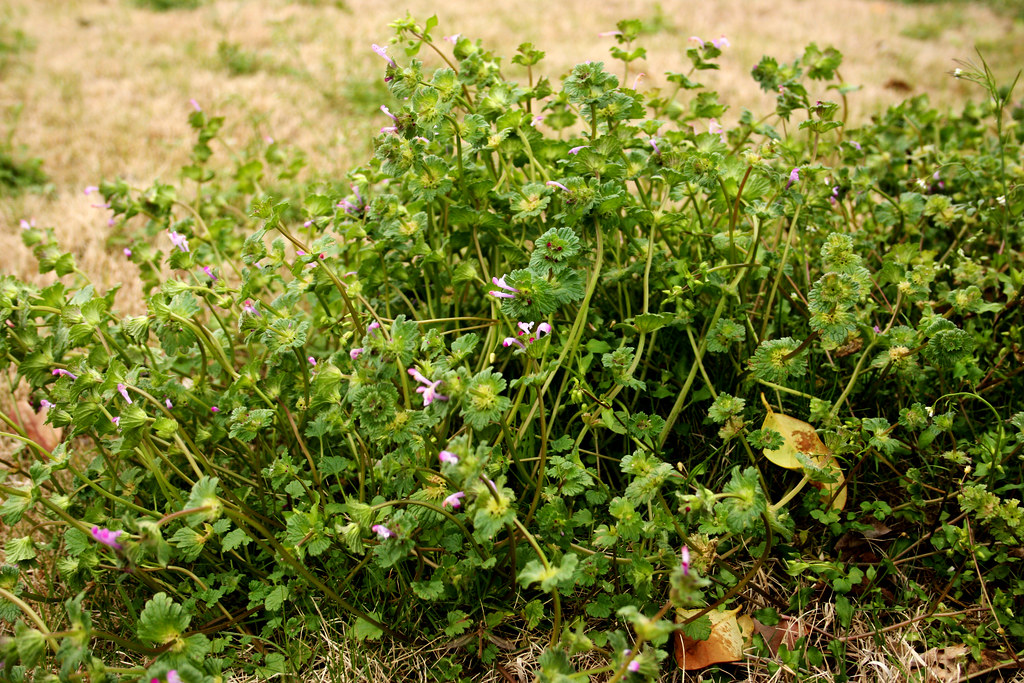
Henbit. Square stems, scalloped leaves stacked around the stem, small purple flowers. That is the weed in the photo up top and the one behind most of the February phone calls.
Chickweed. Low and spreading, small oval leaves, tiny white flowers. It mats up in shade and anywhere that stays damp, which in our clay is a lot of yards.
All three come off the same schedule, which is convenient. One properly timed fall application covers the whole group.
A pre-emergent that never gets watered in is colored dust on your lawn.
This is the most common way a correctly timed application gets wasted, and it is worth understanding even if somebody else is doing the applying.
A granular pre-emergent is an inert carrier with the active ingredient coated on it. Sitting on top of your thatch, it is doing nothing. The product has to dissolve off and move down into the top half inch of soil, because that is the zone where germinating seedlings push through. Until that happens there is no barrier, just fertilizer-looking gravel on your lawn. Leave it sitting and you lose it: sunlight degrades some actives, others volatilize off, and blowing the driveway with product still on it sweeps part of your barrier into the gutter.
What to do instead: plan the water before the bag is ever opened. Most labels want roughly a quarter to a half inch within a couple of days, so either time it ahead of a rain you actually trust or run the sprinklers that evening. Then leave the surface alone. That barrier is a thin continuous layer, and core aeration, dethatching, or cutting a bed edge after the fact tears it open and gives seeds a door. Do that work first, then apply.
What missing the window actually costs you.
It is not just that the lawn looks bad, though it does. It is that every option left to you in February is worse than the one you skipped.
By then the weeds are up, so pre-emergent is off the table. You are into post-emergent work on dormant turf, which is fussier and more prone to going wrong, because warm season grass is not entirely asleep in a mild East Texas winter.
And a heavy stand of henbit or chickweed was holding ground where your grass should have been, so clearing it in late February leaves bare dirt heading straight into green-up. Bare dirt in March is a summer weed nursery, and now you are behind on that window too. Meanwhile whatever went to seed is banked for next year, which with annual bluegrass means you are not fighting this winter, you are fighting the next three.
One East Texas specific note: if you are thinking about overseeding with ryegrass this fall, you cannot do both. A pre-emergent does not know a weed seed from a ryegrass seed. It stops both. Pick one.
So watch the soil, not the calendar, water the product in within a couple of days, and do your aeration and edging before rather than after. We mow and maintain lawns all over Longview, Hallsville, White Oak, Kilgore, and Gladewater, and this is the conversation we end up having every October, usually with somebody who remembers exactly how bad last February looked. We are not a spray outfit, so the application itself is yours or your licensed applicator's to handle. But the timing is the hard part, and now you know how to read it.