Why St. Augustine Dies in the Sunniest Part of the Yard in Late Summer
A patch along the driveway goes straw-colored, you water it twice as long as the rest of the yard, and it keeps getting bigger anyway. That last part is the whole diagnosis.
Every year around the middle of July the calls start sounding the same. St. Augustine dying in one spot, usually the sunniest spot in the yard, and the homeowner has already tried the obvious fix: longer runtimes, hand watering in the evening, twice the water the rest of the lawn gets.
And the patch gets bigger anyway.
When extra water changes nothing, water was never the problem. Something is draining the grass faster than it can drink, and in a full-sun East Texas yard in late summer that is usually chinch bugs.
Drought browns a whole yard. Chinch bugs pick the hottest strip of it.
Heat and dry soil hit everything at once. A drought-stressed lawn goes dull gray-green all over, the blades fold up lengthwise to save moisture, and your footprints stay pressed in the grass behind you. Where it browns first is scattered: wherever the soil is thinnest or the sprinkler coverage is weakest.
Chinch bug damage is one patch with an edge, in the single hottest place in the yard: the strip between the driveway and the sidewalk, the run along a west-facing brick wall that bakes all afternoon. Dead straw in the center, yellowing grass ringing it, healthy green past that, and the whole thing creeps outward week over week while the shaded half of the same lawn looks fine.
The cleanest test costs nothing: watch what a real rain does. Drought-stressed St. Augustine perks up a day or two after an honest inch. A chinch bug patch just sits there.
The green-to-brown edge is where you scout, not the dead middle.
Most people look in the wrong place. They pull back the dead straw in the center, find nothing, and settle on drought. Nothing is in there because there is nothing left to eat. Chinch bugs feed at the advancing front, in the yellowing grass where the damage is pushing into the green.
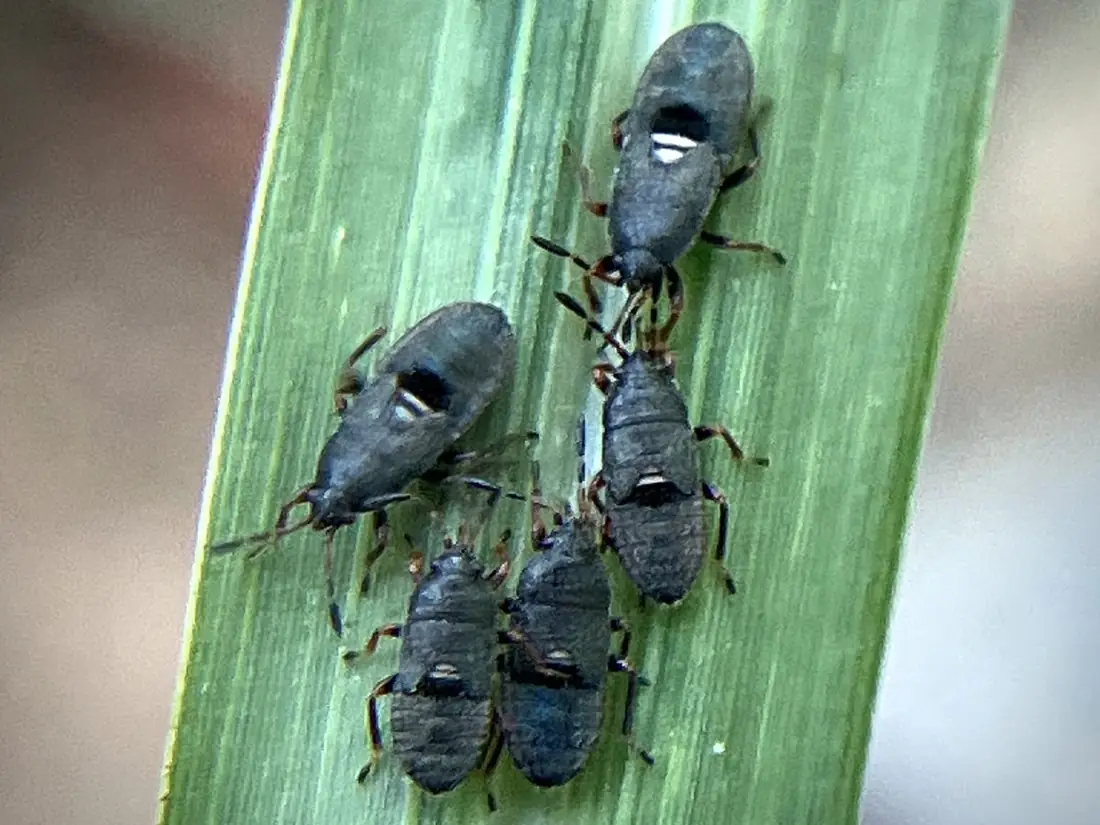
Get down on your knees at that margin, part the grass with your fingers all the way to the soil, and hold it open for fifteen or twenty seconds. Watch the runners and the soil surface, not the blades. Adults are about a fifth of an inch, black, with folded white wings that leave a pale marking across the back. Nymphs are smaller, wingless, and orange-red to brick colored.
If you want certainty, do the can test. Cut both ends out of a large coffee can, twist it two or three inches into the soil at the edge of the damage, fill it with water, and keep it topped off for five minutes. Chinch bugs float. Two or three means they are present. Fifteen or twenty in one can is your answer.
What to do instead: scout that edge before you touch the controller. Adding runtime to a chinch bug lawn only overwaters the healthy grass while the dead spot keeps spreading.
The hottest, driest part of your yard is where they breed fastest.
Chinch bugs are heat insects. The warmer it gets, the faster they develop, so an East Texas summer runs several overlapping generations and the numbers stack up through July and August.
Full sun works against you twice. Hot, dry thatch at the soil line is the habitat they want, and the fungus that normally knocks their numbers back needs cool, damp turf to do it, not the baked strip beside your concrete. Heavy mid-summer nitrogen thickens that thatch, which is both better cover for the bugs and a barrier against anything you put down.
What to do instead: quit pushing quick-release nitrogen in the middle of a Texas summer, keep the deck at three and a half to four inches on St. Augustine so the soil surface stays shaded, and water deep and infrequent. None of that kills a single chinch bug. It makes your yard a worse place to be one.
About products, plainly.
We are a landscaping company, not a licensed pesticide applicator, so I am not going to offer to spray your lawn. But I get asked every summer, so here is how the homeowner side works.
Products sold for home lawns that handle chinch bugs say so on the label, and the label is the instruction manual. Two mistakes come up constantly. People treat only the dead patch when the population is out in the green, so you want the damaged patch plus five to ten feet of healthy grass around it. And people ignore what the label says about water: some granules have to be watered in to work at all, some liquids are meant to stay on the surface. One more thing, since so many East Texas yards were sodded with it: Floratam St. Augustine was selected for chinch bug resistance decades ago, and the bugs caught up with it long ago. The variety will not save you.
What to do instead: confirm the bug first, then follow the label on rate and watering. If you would rather not handle chemicals yourself, that is a licensed pest control job, not ours.
The dead grass is not coming back on its own.
Chinch bug damage is dead grass, not dormant grass, and St. Augustine has no seed you can throw down and no rhizomes to push up new shoots. It recovers only by creeping in from the edges on above-ground runners.
A bare spot the size of a trash can lid closes in a few weeks of warm weather with water and a light feeding. A spot the size of a car will not. That takes most of a season, and weeds reach bare dirt long before grass does. Late July and August is still fine timing to lay St. Augustine sod or plugs here, with two months of growing weather left for it to root before the nights cool off. Waiting until October is how a bare patch becomes next spring's project.
What to do instead: be honest about the size of the hole. Bigger than a few feet across, patch it with sod or plugs now, and water it like new sod.
Three things that look like chinch bugs and are not.
Grubs. Grab a handful of dead turf and pull. Grub-damaged grass peels up like carpet because the roots are chewed off. Chinch bug grass is still anchored down. It is just dead.
Take-all root rot. Common in East Texas St. Augustine and easy to mistake for insect damage. The runners pull loose easily with dark rotted roots and no white feeder roots, and it favors wet or compacted ground rather than the sunniest driest strip in the yard.
A sprinkler problem. A wedge, a stripe, or a hard geometric arc is a coverage map, not a bug. Run the zone in daylight and watch it.
Five minutes at the edge.
I have walked a lot of these yards in Longview, Hallsville, White Oak, Kilgore, and Gladewater, and five minutes at the margin of the patch usually tells you which one it is. Drought you can water. This you cannot. If your sunniest grass keeps dying while the rest of the lawn looks fine, get on your knees and part the grass before you add another minute to the timer.

Miller Maines owns Yard Dog Landscapes in Longview, TX. He has worked East Texas yards since 2017 and still walks every property himself.