Stop Topping Your Crepe Myrtles: The Case Against Crape Murder
Cutting a crepe myrtle back to knuckled stubs every winter does not make it bloom more. It makes it come back taller, on weaker wood, later in the summer. August is the month you can see exactly who did it.
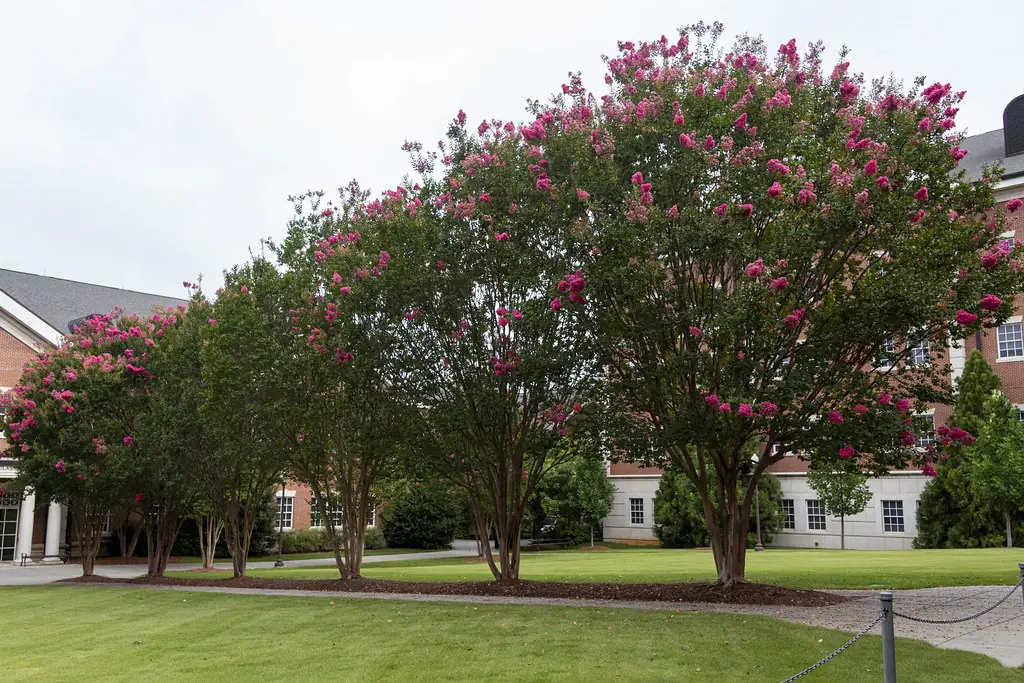
Drive down Judson Road in August and you can play the game I play without meaning to. Which crepe myrtles got butchered last winter, and which ones got left alone. You do not need to know a thing about pruning to tell them apart once the trees bloom.
Crape murder is the nickname for topping a crepe myrtle: sawing every trunk off at the same height, winter after winter, until the cuts callus into knobby fists. It is the most common thing I see done to a good tree out here, and everybody doing it thinks they are helping.
You can pick out the topped trees from the road right now.
A crepe myrtle nobody has cut on is an open vase in August. The branches arch, the flowers ride at the ends of thin wood high in the canopy, and the whole tree moves in the wind.
A topped one blooms in a tight mop at one height, right at the knuckle line, because every flowering shoot started from the same place in April. Those shoots are whippy and thin for their length. Hang a wet panicle on one after a thunderstorm and it bends to horizontal and stays there. A crepe myrtle draped over a sidewalk with flowers at eye level got topped last winter.
It also bloomed late, because it spent spring rebuilding four or five feet of shoot before it had anywhere to put a flower.
Topping does not make a crepe myrtle bloom more.
This is the belief that keeps crape murder alive, and there is a grain of truth in it. Crepe myrtles do bloom on new wood, meaning growth made this season. The leap people make is that you have to force that new wood with a saw.
You do not. A tree nobody touched all winter grows and blooms on its own, earlier and longer, because it is not starting from scratch. Topping trades a canopy full of medium panicles for a few oversized ones on shoots too soft to hold them up.
What to do instead: look at sun before you look at pruning. These trees want six or more hours of direct light. Half the "it quit blooming" calls I get are a crepe myrtle planted in the open years ago with a post oak now grown over it.
The knuckle is a wound the tree never closes.
Where people top, the wood is an inch or two thick, and that cut is too big for a crepe myrtle to seal. It calluses around the outside into the knob while the middle stays open and decays. Rain collects in it. Ten winters of that and you have a fist with rot in the center.
Then there is the attachment. Every new shoot rises out of callus tissue at the rim of that knuckle, not the trunk's own wood underneath. That is a shallow connection carrying real leverage, which is why topped trees throw limbs in storms untouched ones ride out.
You also give up the reason to own one. That cinnamon bark peeling off smooth trunks shows best in January, when nothing else in the yard is doing a thing. A topped tree in January is a row of fence posts with knobs on top.
Cutting it back every winter makes it come back taller, not shorter.
Most people top because the tree outgrew its spot, and topping is the worst tool for that job. Take the top off and the root system, unchanged and now feeding far less growth than it was built for, answers with an emergency flush. Those shoots run four to six feet in one season here. By September the tree is back where it was on weaker wood, and you are stuck repeating it every winter.
What to do instead: accept that variety decides mature size, not pruning. A Natchez wants 25 or 30 feet and no saw is going to talk it down. When the plant is simply wrong for the spot, replace it with one that fits: Sioux and Tonto settle in around 10 to 15 feet, Acoma stays near 10, and Pocomoke is a true dwarf that holds about waist high under a window. Fall is a good planting window here.
Here is how to prune a crepe myrtle correctly.
Timing first. Late winter, which out here means February, while the tree is dormant and before buds break. The leaves are off so you can read the structure, and the tree pushes into the cuts as it wakes.
Then treat the job as removing, not shortening. Take out suckers around the base, sprouts on the lower trunks, branches that cross and rub, branches growing back toward the middle, and dead interior twigs. Everything you cut up top should be pencil to finger thick. If you are reaching for a chainsaw, stop, because you are about to make a knuckle.
One bigger cut is worth making, and that is limbing up: taking a whole low trunk off at ground level to open the vase and show the bark. One or two a year, cut back to where the limb starts instead of leaving a stub. Three to five trunks is the look.
What to do instead of topping: thin it, do not head it. A crepe myrtle pruned right should not look pruned. It should look untouched, only cleaner underneath and more open in the middle.
A butchered crepe myrtle can be brought back.
The gentle way. Next February, go knuckle by knuckle and keep the two or three strongest, best-placed shoots on each, cutting the rest off flush. Repeat the following winter. The shoots you kept thicken into real branches, and in three or four years the knuckles disappear into the canopy.
The drastic way. Cut the tree off at ground level in late winter and let it send up a thicket of shoots. The next dormant season, keep three to five well-spaced ones as the new trunks and remove the rest. You lose a year of bloom and get back clean structure with no knuckles. Where there is decay in the knuckles, that is the one I pick.
In August, the right move is to leave it alone.
You can see the problem most clearly right now, which is exactly when it is most tempting to go fix it. Do not. Hard pruning in August pushes soft growth that will not harden off before our first freeze, around mid-November in Longview.
What to do instead: walk out to the street today, take a picture while the shape is obvious, note which trunks you want gone, and set a reminder for February. That photo beats your memory come winter.
We prune crepe myrtles all over Longview, Hallsville, White Oak, Kilgore, and Gladewater, and plenty of those are recovery jobs on trees topped every winter for a decade. They come back. It takes a plan and two seasons of restraint.

Miller Maines owns Yard Dog Landscapes in Longview, TX. He has worked East Texas yards since 2017 and still walks every property himself.