
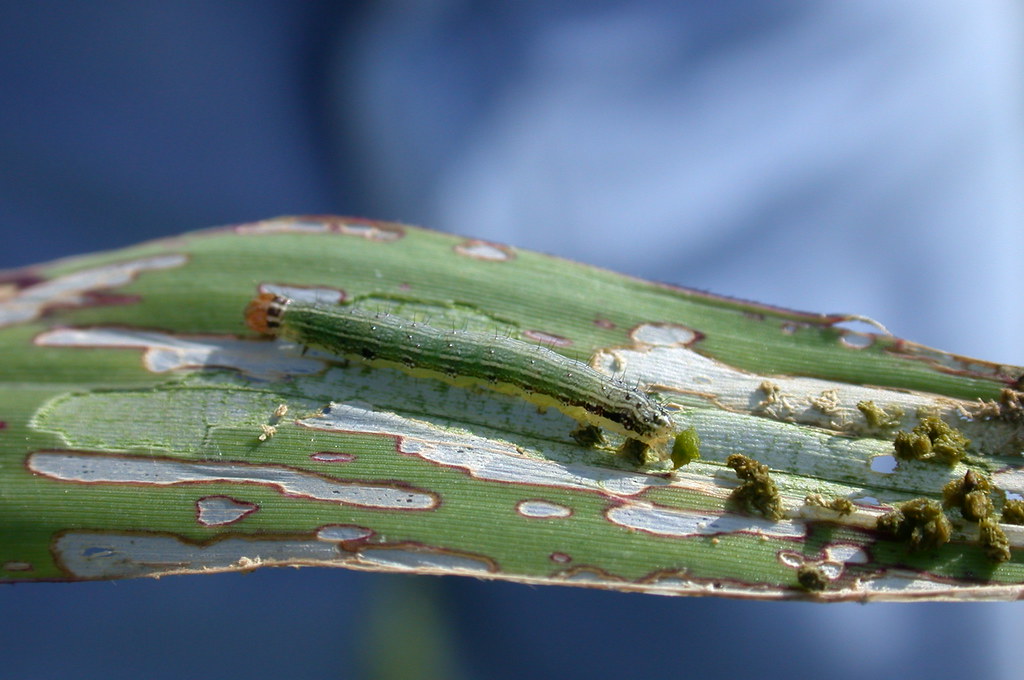
I have walked yards in August where the homeowner met me in the driveway convinced the irrigation had quit. Perfect green bermuda two days ago, now a big tan section that looks scorched, with a hard edge running across the lawn like somebody dragged a line through it.
It is almost never the sprinklers. Drought does not draw a straight line. Armyworms do.
They are not really our worms. They are visitors that arrive every year.
Fall armyworms do not reliably overwinter this far north. The moths ride weather up from South Texas and the Gulf Coast every year, breed, and their offspring do the eating. The generations stack as summer goes on, which is why the big damaging pushes land from late July through September here, sometimes into October if we stay warm.
What they want is exactly what a proud homeowner grows. Lush, fertilized, well-watered bermuda tops their menu, along with hay meadows, new sod, and fall-overseeded ryegrass. The nicest lawn on the street gets eaten first.
One local wrinkle. A lot of our neighborhoods back up to pasture and hay ground, and when a bermuda meadow gets cut and baled, the worms in it lose their groceries in an afternoon and they walk. If your back fence line browns first and the damage marches toward the house, look over the fence for fresh round bales.
The warning signs show up days before the lawn goes brown.
Small armyworms cannot chew through a blade yet, so they scrape one surface and leave the thin membrane behind. Up close that is windowpane feeding, like the photo above. From standing height, a lawn full of it looks faintly silver, like somebody misted it with whitewash. That frosted cast usually shows up three to five days before the collapse.
Then there are the birds. Grackles, cattle egrets, killdeer, whatever is around, working your lawn in a tight busy flock and not moving on. They are not there for grass seed. They are there because the buffet opened, and they are almost always right.
The third sign is moths. Small drab brown and gray moths flushing up out of the turf ahead of your mower, or swarming the porch light in August, is the egg-laying generation announcing itself. Egg masses often go on flat vertical surfaces near the lawn, so check the eaves, fence rails, and the sides of the mailbox for fuzzy tan patches that look like lint.
What to do instead: stop waiting for brown. From late July on, look down at the lawn once a week in low sun for that frosted cast, and treat a working flock of birds as a reason to go check the grass that day, not a curiosity.
Five minutes with a bucket of soapy water settles it.
Armyworms hide down in the thatch during the heat of the day, so digging around at 2 PM tells you nothing. The reliable check is a soap flush.
Mix a couple tablespoons of lemon-scented dish soap into a gallon of water and pour it evenly over about a square foot of turf. Wait three minutes. Anything living down in the thatch comes to the top.
Where you pour is the part people get wrong. Do not test in the middle of the brown. They already ate that and left. Test in the green grass right at the advancing edge, and do a couple spots so you are not judging the yard off one square foot.
What comes up is easy to identify. Fall armyworms have a pale upside-down Y on the front of a dark head capsule, and four dark dots in a square near the back end. Slender worms in silk-lined tunnels with little green pellets are sod webworm instead, a different pest on a slower clock. As a working number, three or more armyworms per square foot in a home lawn is when it is worth acting rather than watching.
How big they are decides how the story ends.
This is the part almost nobody knows, and it is the whole reason early scouting pays.
An armyworm does the large majority of its lifetime eating in its last few days, at full size. So a lawn full of quarter-inch worms and a lawn full of inch-and-a-half worms are different situations even if the counts match. The little ones have barely started. The big ones are nearly done, they are much harder to kill at that size, and they may already be headed into the soil to pupate.
That is why treating the frosted stage works and treating the tan stage often does not. Homeowner products labeled for turf caterpillars run from Bacillus thuringiensis and spinosad, which are gentler and work best on small larvae, up to synthetic pyrethroids for heavier pressure. Bt has to be eaten and breaks down in sunlight, so it goes out late in the day when the worms come up to feed. Mow first so the material lands on the grass instead of the tops of tall blades, and understand that anything applied this week does not end the season. The moths keep coming.
What to do instead: scout to the frosted stage and act on small worms. Chasing full-grown worms across a lawn that is already tan is money spent on a battle that finished before you got there. Your effort belongs on recovery.
Most East Texas lawns recover. Two kinds do not.
Here is the good news that surprises people standing in a brown yard: armyworms eat leaf tissue. They do not eat crowns, roots, or rhizomes. Established bermuda chewed to the dirt in August is not dead. It is defoliated, which looks far worse than it is.
Keep water on it, give it a light feeding to push new leaf growth, and stay off it while it comes back. Two or three weeks of August heat and moisture and most established bermuda greens up like nothing happened.
The two that struggle are the ones to worry about. First, new sod or a spring-sprigged lawn that has not built root reserves yet. It does not have the bank account to regrow a whole canopy, and it can genuinely be lost. Second, a lawn hit late, in October, when there is not enough warm growing season left to recover before dormancy. That lawn goes into winter thin, and thin bermuda in spring means a weed problem waiting on you in March.
The other quiet cost is competition. Bare soil in September is an open invitation, so a stripped lawn that gets ignored comes back with more weeds in it than it had before.
If your grass went from green to tan in a couple of days and you want a straight answer, we walk lawns all over Longview, Hallsville, White Oak, Kilgore, and Gladewater. We will tell you whether it is armyworms, drought, or disease, and lay out the mowing, watering, and feeding plan that gets it growing again before fall.