Fall Beats Spring for Planting Trees and Shrubs in East Texas
Every March the phone starts ringing about shade trees. I understand it, but the best window all year for putting a tree or a shrub in the ground in Gregg County just opened, and it closes around Thanksgiving.
Spring is when the garden centers fill up. That is a marketing calendar, not a horticultural one, and down here the two run opposite.
The soil out here stays warm long after the air quits being miserable.
Air temperature and soil temperature are two different clocks, and the soil clock runs weeks behind. By mid-September our afternoons have backed off into the eighties, but four inches down the ground is still close to seventy degrees. It holds in the sixties through most of October and does not fall into the fifties until well into November.
Woody roots keep growing as long as soil stays above roughly forty degrees, and in East Texas that covers most of the winter. We get cold snaps, not a frozen season. Ground under a couple inches of mulch thaws back out in a day.
So a tree set out in early October goes into warm soil under cooling air, and that is the whole argument. Warm soil means the roots are working. Cool air means the leaves are not pulling more water than a small root system can deliver.
A tree planted in October gets six months of root growth. One planted in April gets eight weeks.
Run the arithmetic. Plant the first week of October and you have seven months before the first hard stretch of upper nineties. Write off the coldest weeks and that is still close to six months of root growth out past the ball.
Plant that same tree in early April and you get eight weeks. Our first hundred-degree day lands in June, sometimes late May.
Here is the part people miss. A container tree arrives with a root ball of light bark-and-peat potting mix. Your yard is East Texas clay, or the sandy loam over clay north of Longview. Water does not move readily between textures that different, so until roots grow out into native soil, the plant is drinking from a buried container.
That ball dries out in about a day and a half in July. The clay six inches away can be plenty moist and the tree still wilts. It is why spring-planted trees die in August while the homeowner swears the yard got watered. It did. The root ball did not.
What to do instead: if you already have a spring-planted tree out there, run the hose on a trickle right on top of the root ball for twenty minutes twice a week all summer. Not the sprinkler zone. The ball itself.
Fall planting does not mean you stop watering.
This is where the fall window goes wrong. The weather turns nice, nothing looks like it is suffering, and everybody quits watering around Halloween.
The schedule I give is short. First six weeks, soak the root ball twice a week. September and early October are often our driest stretch of the year, so a September planting needs what a June one would. Late October through November, once a week. December into February, every ten to fourteen days whenever we go two weeks without a soaking rain.
Soak means slow. An irrigation zone running twelve minutes wets the top inch and does nothing for a ball a foot deep. A hose on a trickle for twenty minutes does it, or a five-gallon bucket with two small holes drilled in the bottom, set on the ball.
The one that actually saves plants: water hard ahead of a hard freeze. When a front is dropping us into the low twenties, soak everything new the day before. Wet soil holds heat far better than dry, and most winter damage I see on young plants is not freezing, it is desiccation. Frozen ground, a dry root ball, and north wind is what browns out a new holly or wax myrtle. February of 2021 sorted a lot of yards around here, and the ones that came through best went in with wet soil under them.
What to do instead: set a repeating reminder on your phone that runs through February. It is most of the difference between a tree that establishes and a tree you buy twice.
In our clay, how deep you plant matters more than when.
The window helps you, but it does not rescue a bad hole. The root flare, where the trunk widens into its first roots, belongs at grade or an inch above. On container stock it is often already buried two or three inches under the potting soil, so measure to the flare, not the top of the pot. Planting too deep in clay is the most common way I see a new tree killed, and it takes two or three years to finish, which is why nobody traces it back to planting day.
Dig wide and shallow: two to three times the width of the ball, no deeper than the ball is tall. Roots run sideways here, not down. And leave the backfill alone, native soil back in. A hole of bagged garden soil in the middle of clay is a bathtub. Water runs in, does not run out, and roots circle in that soft pocket.
Skip fertilizer at planting too. Nitrogen in fall pushes soft top growth right when you want everything going into root. Mulch two to three inches deep and as wide as you can stand, pulled back off the trunk. Mulch against bark holds moisture there and rots it.
There are a few things I would not put in the ground in October.
Fall is not universal. Container-grown shade trees, live oak and Shumard oak, Chinese pistache, redbud, crepe myrtle, hollies, boxwood, ligustrum: all of it goes in now and is better for it.
What I hold until spring is anything sitting at the edge of its cold hardiness. We straddle zone 8a and 8b depending on where you are in the county, and every decade or so we get a week that behaves like zone 7. A marginal plant wants a full season of root under it first. Bare-root fruit trees and roses are a separate calendar: dormant, December through February.
Watch what you are buying, too. September and October are clearance season at every nursery around here, but a plant that sat in a pot since March is often root bound. Slide it out and look. If roots circle the outside of the ball, run a knife down the sides in three or four cuts an inch deep and tease the bottom apart. Roots that never get cut keep circling, and years later they girdle the trunk.
What to do instead: buy the smaller tree. A seven-gallon tree planted in October usually passes a thirty-gallon tree planted the same day inside four years, because it establishes faster and never spends a summer in shock.
We plant trees and shrubs all fall across Longview, Hallsville, White Oak, Kilgore, and Gladewater, and this is the stretch of the year when the work actually takes. If you have been holding a shade tree or a foundation bed for spring, spring is the harder road. Call us and we will walk the yard, tell you what fits the spot and the drainage, and plant it while the ground is still working.
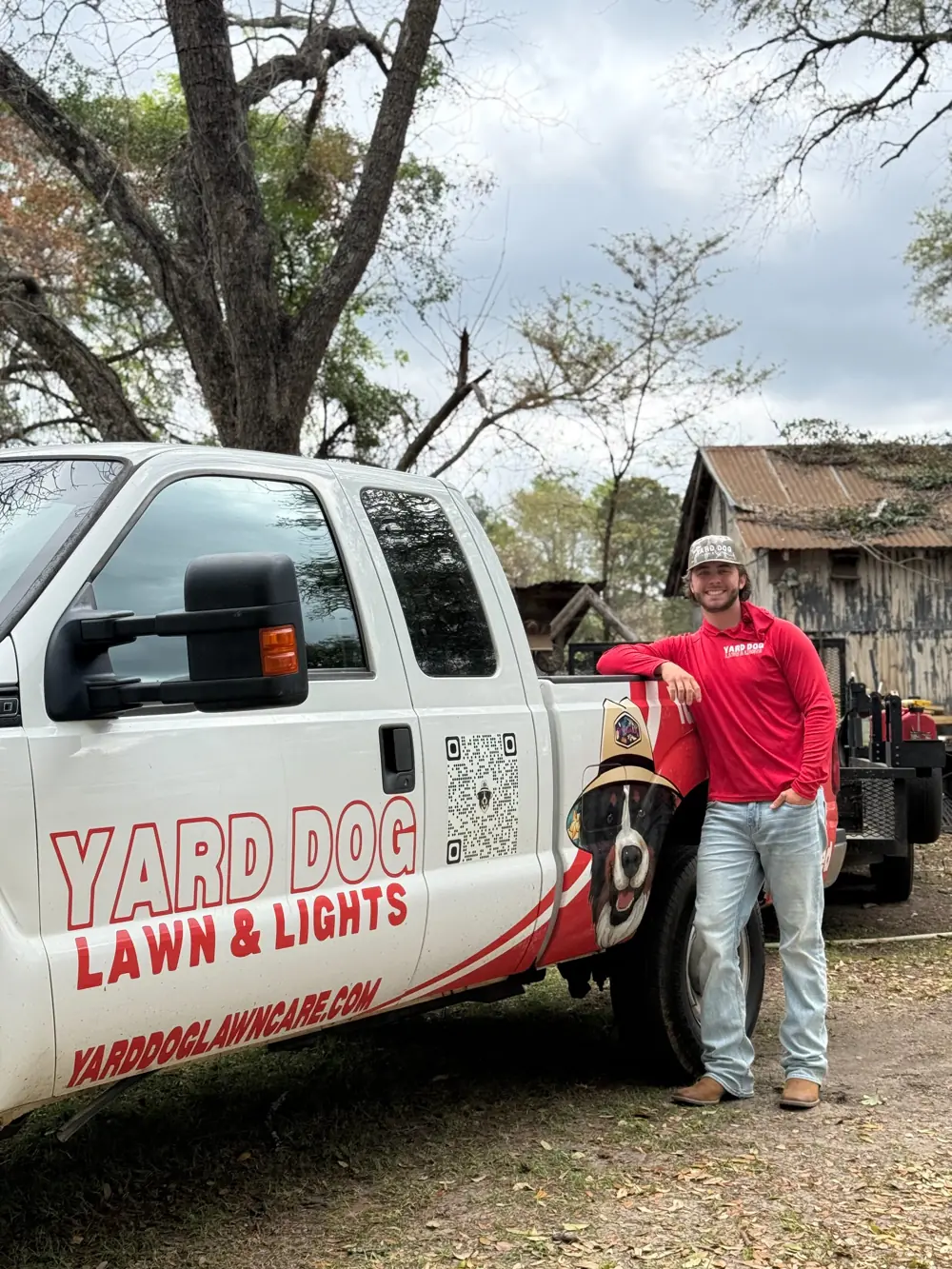
Miller Maines owns Yard Dog Landscapes in Longview, TX. He has worked East Texas yards since 2017 and still walks every property himself.