The Webbed Nests Taking Over East Texas Pecans in Late Summer
Two or three white bags of webbing show up on the ends of the pecan limbs in the last week of August, and by mid-September there are fifteen. Here's how to tell what you're looking at, and how to decide whether it deserves a ladder.
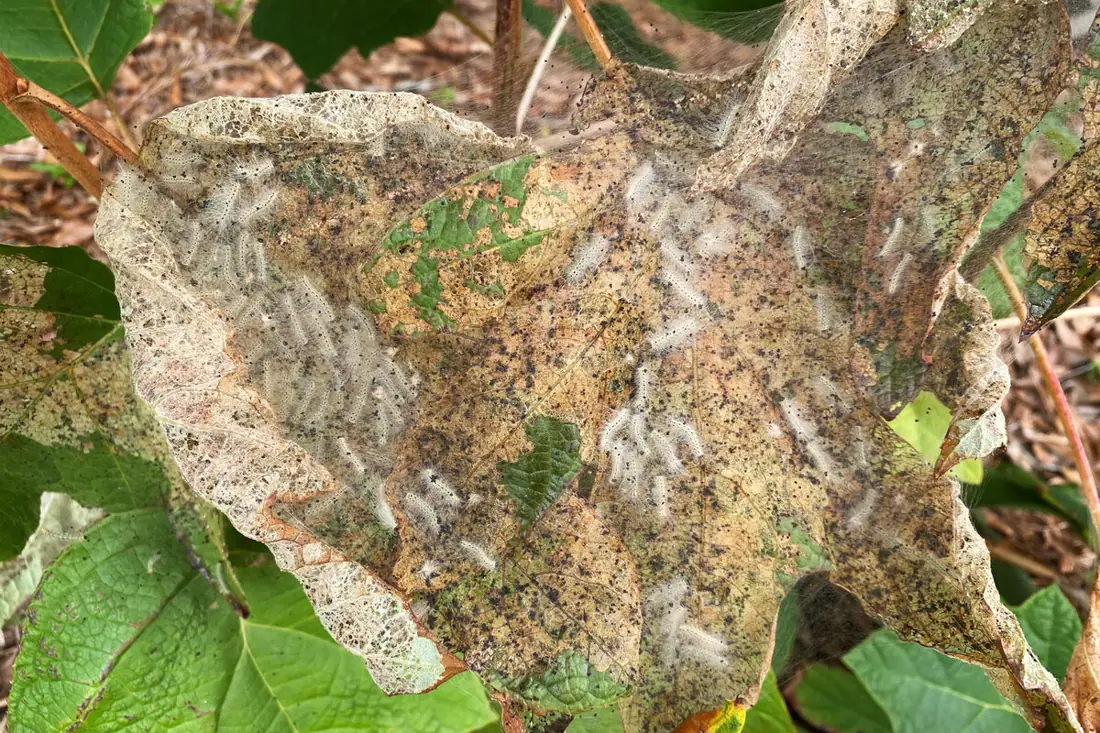
Three different insects get called webworms around here, and only one of them is what's in your pecan in September. Two are cosmetic on a big tree. The third actually kills what it's on.
Where the web sits tells you what you have.
Fall webworm builds at the end of a branch, wrapped around the leaves. The caterpillars feed inside and push the web outward as they strip it, so a nest that covered one leaf cluster in August can swallow four feet of branch tip by late September. Inside: pale long-haired caterpillars, dark frass in the silk, leaves chewed to the veins.
Eastern tent caterpillar builds in the crotch where limbs fork, and those caterpillars leave the tent to feed and come back. It's also a spring insect here, March and April, mostly on wild cherry and plum. In September you're not looking at tent caterpillars.
Bagworms build no shared web at all. Each one makes a spindle-shaped bag out of bits of whatever it's eating and hauls it around, so on a juniper it reads as a ragged little pinecone on a thread. They go after our evergreens: red cedar, junipers, arborvitae, Italian cypress.
That's the distinction that matters, and it runs backward from what people expect. The web in the pecan is cosmetic. The little bags on the arborvitae are the killers, because an evergreen doesn't refoliate the way a pecan does. Strip a juniper and those branches stay brown.
What to do instead: before you react to the web in the tree, check your junipers and arborvitae for bags. If you've got both, the bagworms are worth your afternoon.
Why it's always the pecans, persimmons, and sweetgums out here.
Fall webworm eats several hundred species, so the host list is useless. Its favorites here are the useful part: pecan and hickory first, then persimmon, sweetgum, mulberry, black walnut, and river birch in the bottoms. Now look at what grows in Gregg County.
The other reason is season length. Up north this insect gets one generation a year. Down here it gets two, and in a warm year three. The late-summer round rides on everything that survived the early one, which is why the tree looked clean in June and looks infested by Labor Day.
Moths lay close to where they came from, so a tree that had nests last year will likely have them again. That's not a sign your tree is sick. It's a sign your tree is a pecan in East Texas.
A pecan carrying nests in September is closer to leaf drop than it looks.
Here's the math nobody does. A pecan in Longview holds its leaves into early November, so nests showing up in late August hit a tree with ten weeks of leaf left that has already banked most of this year's carbohydrate.
Defoliation in May is a real problem: the tree spends reserves rebuilding a canopy, then lives off it for five months. In late September it costs the tail end of a season the tree already finished. Three trees outside Gladewater got hammered three years running and came back full every spring.
The exceptions matter. A tree in its first two or three years has no reserves and a small canopy, so two nests can be a third of its leaves. A tree already stressed by drought or construction damage has less margin. And a pecan you harvest is different, because the leaves working in August and September are the ones filling the kernels.
What to do instead: on a mature shade pecan with a few nests and nothing else wrong, leave the webs and water the tree. A deep soak every couple of weeks through a dry September does more for it than pulling nests.
When pulling a nest out is actually worth the trouble.
My rule is short: it's worth it if a pole pruner reaches it and the cut is one I'd have made anyway.
What I get called out to look at afterward is a three-inch scaffold limb somebody sawed off to reach one nest in a forty-foot pecan. You traded a web that disappears at leaf drop for a permanent hole in the canopy and a big wound heading into fall.
The better move costs thirty seconds: don't cut, just open the web. That silk is armor, the only reason a soft, slow caterpillar can sit on a branch in daylight. Tear it and paper wasps, birds, and the parasitic wasps and flies doing most of the real control all get in.
Size decides how easy that is. A fist-sized nest over one leaf cluster is a single twig clip. A bushel-basket nest holds nearly grown caterpillars that are almost done eating anyway.
What to do instead: walk your pecans and sweetgums in mid-July and again the first week of August, looking at branch tips. Nests you catch small come off from the ground with a pole. Nests you find in mid-September aren't worth the ladder.
On products, since it comes up every year: Bt (Bacillus thuringiensis kurstaki) is the material that fits this insect. It has to be eaten, so it only works on leaves small larvae are still going to chew, and webbing sheds spray. Read the label. And a homeowner sprayer throws twenty feet, while the nests on a mature pecan are at fifty.
Do not burn the nests out of the tree.
Somebody tries this every year with a torch on a pole. It works on the web. It also cooks the cambium under the bark of the limb you're holding the flame against, and that doesn't grow back.
Webworm damage is temporary and the tree fixes it in April. A scorched limb is permanent, and it's an open door for borers. September is also our driest stretch, so that's open flame in dry foliage over pine litter.
What to do instead: put an old rake head on an extension pole, twist it into the web, and pull the silk open. If a whole nest comes down, step on it or bag it, since larvae in the grass climb back up the trunk.
The gray webs still hanging up there in December are already empty.
Once the leaves are down, the caterpillars are gone. They drop and pupate for the winter in leaf litter, loose bark, and the top inch of soil. The webbing tatters and hangs in the bare canopy until spring, which is why every January somebody assumes it's still infested.
It isn't, and cutting old webs out in the dormant season buys you nothing. Raking litter out from under the tree helps a little, since that's overwintering ground. A little is the honest word. Moths fly, and your neighbor's pecan is two hundred feet away.
We're in pecans, sweetgums, and persimmons all over Longview, Hallsville, White Oak, Kilgore, and Gladewater this time of year, and on a webbed-up mature shade tree the honest answer is usually that it looks worse than it is. A young tree, a nest a pole can reach, or a limb that needed pruning anyway is worth a visit. If you can't tell which one you've got, give us a call.

Miller Maines owns Yard Dog Landscapes in Longview, TX. He has worked East Texas yards since 2017 and still walks every property himself.